

E-Blox Circuit Blox Student Set - 120 STEM Projects Educational Building Toy
E-Blox Circuit Blox Student Set - 120 STEM Projects Educational Building Toy
Best For
Couldn't load pickup availability
Product Overview
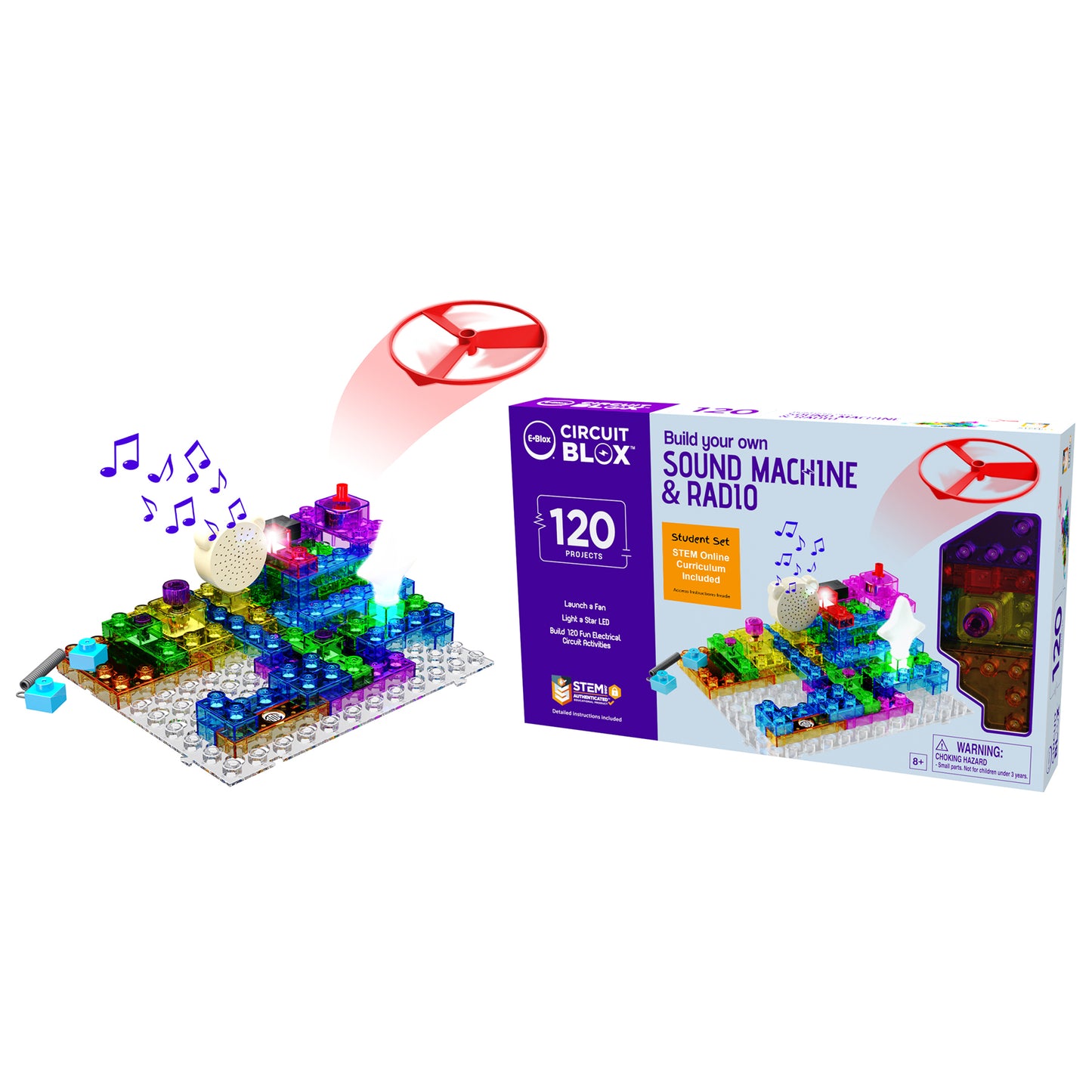
The E-Blox Circuit Blox Student Set brings 120 hands-on STEM projects to students in grades 3-5, teaching electricity, circuits, and telecommunications through construction-based learning. Kids build working 3D circuits that light up stars, spin motors to launch fans, and play music and sirens, and create everything from a real working FM radio to a flying saucer. Compatible with other brick building sets, the Circuit Blox system lets students discover how lights, alarms, motors, and switches work while building functional circuits that demonstrate the basics of electricity.
- Build 120 different projects including a working FM radio, flying saucer, and circuits that light up, spin motors, and play sounds
- Teaches electricity, circuits, and how various electronic components work through hands-on construction for students in grades 3-5
- Includes 79-page teacher guide with curriculum lessons addressing NGSS requirements, plus online animated lessons and quizzes
- Compatible with other brick building sets for expanded building options
You May Also Like


Mickey Mouse 15-Inch Fly Wheel Cruiser Ride-On


Masters Of The Universe Movie Battle Cat 11-Inch Creature Figure With Chomp & Roar


Hot Wheels Buzz Lightyear Star Command Adventure Track Set With Die-Cast Vehicle


Disney Pixar Toy Story 5 Blaze's Pet Pig Interactive Feature Plush Toy


Disney Pixar Toy Story 5 Lil' Partner Bullseye Interactive Posing Horse Figure


Disney Pixar Toy Story 5 Critter Talk Jessie 12-Inch Action Figure With Pig


Fashems My Little Pony Collectible Squishy Mini Figures


Star Wars The Child Grogu 10-Inch Interactive Plush With Sound And Movement


Nerf Star Wars The Mandalorian Rocket Gauntlet With 6 Darts Ages 5+


Star Wars ActionVerse AT-RT & Imperial Remnant AT-RT Driver Vehicle Set


VTech Baby Hello Hippo Soft Phone Toy - Ages 6+ Months


Star Wars The Mandalorian Electronic Mask With Sound Effects


AquaPlay Harbor Waterway Playset With Crane, Pump, Slide, 3 Boats And 2 Figures


Super Mario Yoshi Egg Galaxy Movie Action Figure Playset


JAKKS Pacific Super Mario Galaxy Movie Bowser Jr. 5-Inch Action Figure Set


Super Mario Galaxy Movie 5 Inch Collector Yoshi Figure


Super Mario Galaxy Movie - 5" Mario Action Figure Set


SUPER MARIO Movie Gateway Galaxy Diorama Action Figure Set


Barbie Signature Kylie Minogue 12 Inch Collectible Doll


Play-Doh Disney Junior Mickey Mouse Stamp and Go Creative Megapack


Disney Princess 11.5" - Rapunzel Fashion Doll


Disney Princess Fashion Doll - Moana 11.5 Inch


SEGA DC Comics Sonic & Batman 6-Inch Action Figures - Shadow & Batman Duo


Sonic The Hedgehog Deluxe Action Figures - Tails & Cyborg 6 Inch Collectibles


SEGA DC Comics Sonic & Superman Action Figures - Ultimate Hero Pack


SEGA DC Comics Sonic & Wonder Woman 6 Inch Action Figures - Dual Pack


Hot Wheels Mega Loop Garage - Ultimate Racing Playset


Imaginext Disney Pixar Toy Story Pizza Planet Playset With Buzz Lightyear


Fisher Price Little People My Mario Bowser's Airship Playset


Fisher Price Little People Disney Jr. Mickey and Minnie Musical Train


Fisher Price 3-in-1 Kick and Sway Activity Gym – Sensory Delight


Discovery #MINDBLOWN Sensory Science Test Tube Chemistry Lab Set


Barbie Cutie Reveal Cuddly Series Doll - Plush Animal Costumes


Barbie Petal Pop Scented Fashion Doll - Blossom Beauty


Barbie Deluxe Style Fashion Doll - Denim Star-Print Dress


Barbie Deluxe Kitchen Playset with Doll - Blonde Bun
Full Details
Use Cases
- Hands-on STEM learning in grades 3-5 classrooms
- Home science enrichment for elementary students
- Virtual e-learning curriculum supplement
- Gift for children interested in electronics and engineering
- After-school STEM club activity
- Summer learning project to explore circuits and electricity
Skills Developed
- primary skill: Understanding of electricity and circuits through hands-on circuit building
- problem solving: Troubleshooting and assembling 120 different electronic projects
- fine motor: Connecting circuit components to build functioning devices
Age Suitability
- minimum safe age: 8 years
- ideal age range: 8-11 years
- developmental fit: 8-10 years: Builds understanding of electricity, circuits, and telecommunications through hands-on project construction. 11-12 years: Applies circuit concepts to increasingly complex builds including working FM radios and sound-generating devices.
- grows with child:
- upper age note: The 120 projects range from simple to complex, supporting progression through elementary and middle school STEM learning.
Play Patterns
- primary play type: Construction-based learning with electronic components
- play structure: Project-based building following instructions to create functioning circuits and devices
- social context: Individual or small-group classroom activity with teacher guidance
- adult involvement: Teacher or parent guidance recommended, especially for younger students working through circuit concepts
- play progression: Starts with basic circuit builds and advances through 120 projects of increasing complexity
- session length: Individual projects vary from simple circuits to complex builds like working FM radios
Why It Works
- primary benefit: Hands-on construction allows children to discover how lights, alarms, motors, and switches work while building 120 different functioning circuits.
- secondary benefit: The 79-page teacher guide with curriculum lessons provides structured learning that addresses Next Generation Science Standards for grades 3-5.
What Makes It Fun
- Build 120 different 3D circuits that light up stars, spin motors to launch fans, and play music and sirens.
Why They'll Love It
- * 120 different 3D circuits light up, spin motors, play sounds * Teaches electricity and circuits concepts. * Designed for students in Grades 3 through 5.
Customer Q&A
How many projects can be built with this set?
The set includes 120 different projects.
What types of projects are included?
Projects include building a working FM radio, a flying saucer, 3D circuits that light up, motors that launch fans, and devices that play music and sirens.
Does it include a teacher guide?
Yes, the set includes a comprehensive 79-page teacher guide with curriculum lessons.
What grade level is this designed for?
The set is designed for students in grades 3-5.
What STEM concepts does it address?
The set teaches electricity, circuits, and how various electronic components work, and the curriculum addresses Next Generation Science Standards requirements.

